A Recontextualization of Authorship and AI’s Harms and Uses
Forthcoming in: Durt, C. (2026). LLMs and the Death of the Author: A Recontextualization of Authorship and AI’s Harms and Uses. In N. Erinakis & A. Afentoulidou (Eds.), What Does It Mean to Be a Writer Today? I Write, Translate, Think in the Age of Artificial Intelligence. Gutenberg.
Abstract
Large Language Models (LLMs) impact authorship on multiple levels. This essay revisits the concept of authorship through the context of Barthes’s critique and subsequent reflections by Derrida and Foucault. It examines how Coeckelbergh and Gunkel apply this critique to LLMs and connects these ideas to the work of Luhmann, Esposito, and Latour.
The essay challenges the sender-receiver concept of communication of meaning that underlies both traditional theories of authorship and their critiques, as well as common conceptions of text-generating AI, such as the Turing Test. Rather than assuming that meaning resides solely in the author or the reader, meaning emerges from interactions within a shared implicit context. Most of this context remains tacit and can only be partially articulated.
LLMs work exclusively with explicit context (co-text). While they influence writing, they are neither authors nor co-authors. While LLM-generated text depends on massive corpora of human-authored training data and is hence not authorless, it replaces the mindful synthesis of context by authors with a multitude of human labor processes, design decisions, and user interpretation.
Authors don’t simply operate within a given context. Rather, they actively rework it to create new forms of meaning. This crucial work by the author can be either supported or undermined by LLMs. The most common uses of LLMs—such as letting them draft entire texts—weaken authorship and contribute to deskilling. The essay outlines better uses of LLMs that can strengthen authorship while also considering their dangers.
1. Introduction
Large Language Models (LLMs) and other AI are massively changing the conditions of authorship. Some changes are easy to see. For instance, LLMs enable the mass generation of low-quality text. This had already been a problem, but AI accelerates the unprecedented and rapidly growing flood of slop swamping the internet, articles, and books. There is always more text of the kind of text philosophy has a terminus technicus for: “bullshit.” Bullshit is characterized by “indifference to how things really are” (Frankfurt, 2005, p. 35). While Frankfurt’s notion of “how things really are” ignores that objectivity is not a simple given, he is right about the indifference inherent in “bullshitting.” Since LLMs generate text by reassembling what is in their training corpora, inherently, they neither care about truth nor about the consequences of the content of the text they generate.
However, this aspect represents only one relatively small shift in the conditions authors must navigate. A less visible change is that “how things really are” is increasingly defined by AI companies—or sold to the highest bidder. Their algorithms guide, amplify, or stifle traffic. LLM chatbots can be intentionally manipulated to promote conspiracy theories and deny the Holocaust (Kassam, 2025). AI companies train their models on texts humans have written over millennia, siphoning away the often meager profits that authors and publishers can make from their work. Publishers are drowning in submissions, and LLM-generated text increasingly appears in their journals and books. These are just some examples of increasingly threatened conditions of authorship. While this trend predated LLMs, their acceleration and amplification of it only strengthen the case that we do not need more low-quality writing. We need better writing.
While the problems of LLM-generated text grab headlines, it is harder to see how LLMs might contribute to high-quality writing. In fact, LLMs threaten our very ability to learn to write. Schools and universities can no longer rely on home-written essays and theses, which have long been fundamental to education. Thus, LLM-generated text not only causes large-scale deskilling of work, including that of writers, but also prevents people from acquiring pertinent skills in the first place.
Moreover, human authorship is increasingly ceded to obscure “black box” processes. Even authors who draft text themselves and then use LLMs to correct expressions, improve the text’s readability, or let LLMs question arguments or make suggestions face dangers. Since LLMs favor patterns that appear frequently in their training data, they are particularly apt to suggest more common expressions and thereby can contribute to making texts more readable and understandable. These very capabilities, however, are also likely to flatten style, content, and argumentation. LLMs state reasons and arguments in often convincing ways that, however, can also flatten content and may make authors overconfident in claims that should be hedged and limited to a clear context. Their ability to attune to specific authors and their styles, as well as the sycophancy resulting from training for pleasing answers, make LLMs problematic advisors.
Given these fundamental challenges, we need to ask fundamental questions about writing and authorship. How do LLMs impact authorship? Are they authors themselves? Are they killers who finally finish off the long-endangered author and hence complete the long-announced “death of the author”? And, on a less apocalyptic note, are there ways to use LLMs to support authorship and promote good writing despite the problems they bring?
Questions like these were discussed at the International Conference “The Position of Writers in the Age of Artificial Intelligence” organized by the Hellenic Authors’ Society, the National and Kapodistrian University of Athens, and the Goethe Institute in Athens in February 2026. This essay’s author gave an oral talk on the topic, which is available as a video recording (Durt, 2026). This essay is a rewrite of the presentation, incorporating insights from the Q&A session and adapting the spoken presentation to the written format.
Writing allows for more precise, detailed, and complex formulations. Readers can follow graphical elements, read dense parts carefully, easily reread them, or quickly jump to other sections. The specifics of written text made the rewrite of the oral talk advisable, and the resulting essay shows some of the possibilities of writing in contrast to the oral presentation. LLMs were used for research, to transcribe and reassemble the presentation, to help reformulate writing, and to generate figures. However, this was also a telling exploration of the limits of current LLMs in philosophical investigations at the limits of language. Most of the substantial suggestions made by LLMs sounded insightful, but either distorted the meaning of the text, missed crucial points, or phrased them in misleading ways, and have hence not been followed. However, the very misrepresentations produced by LLMs were helpful for reflecting the points of the essay.
While the philosophical approach of this essay may differ from that of creative writers, the theoretical and conceptual work aims to clarify the fundamental challenges that LLMs pose to all authors. This requires rethinking the concept of the author and their role in communication.
2. The traditional Western Picture of Communication and its Deconstruction
The traditional Western picture of communication attempts to account for the relationship between author, language use, and listener or reader with a simple transmission model. The author uses language to encode their thoughts into a physical medium. The reader or listener then recreates these thoughts in their own mind. For instance, Ferdinand de Saussure argues in his groundbreaking Cours de Linguistique Générale that linguistic signs encode concepts in the brain, where the author’s “facts of consciousness” become associated with “sound images or signs.” These signs are transmitted through space, then decoded through the eyes or ears and received in another person’s mind.[1]
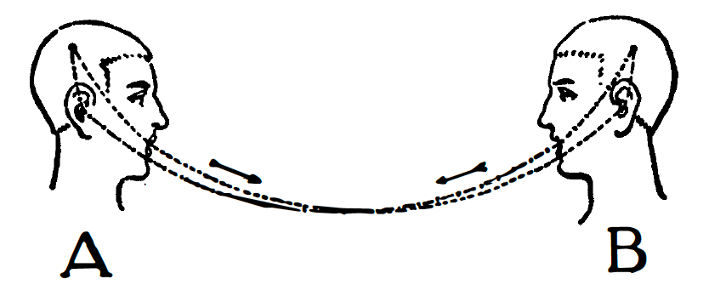
Figure 1 from Cours de Linguistique Générale, p. 27
This view of communication suggests that the reader’s role is to reconstruct the author’s thoughts, which is an ancient idea, possibly older than writing, and revived in new contexts. Saussure did not invent this way of thinking about communication himself but adopted an idea that seemed as self-evident to him as it did to many other linguists, psychologists, brain scientists, and philosophers before and after him. Later authors not only carried on this framework but radicalized it in important ways. Behaviorism, for instance, completely rejected the idea of internal mental states, consciousness, and meaning (Watson, 1924). Other models avoid behaviorism’s strong ontological commitments and nevertheless take the same direction. While the sender-receiver model of information is not bound by the rejection of mental states, consciousness, and meaning, its scope is intentionally confined to the technical aspects of information transmission (Shannon, 1948), not to “facts of consciousness.”
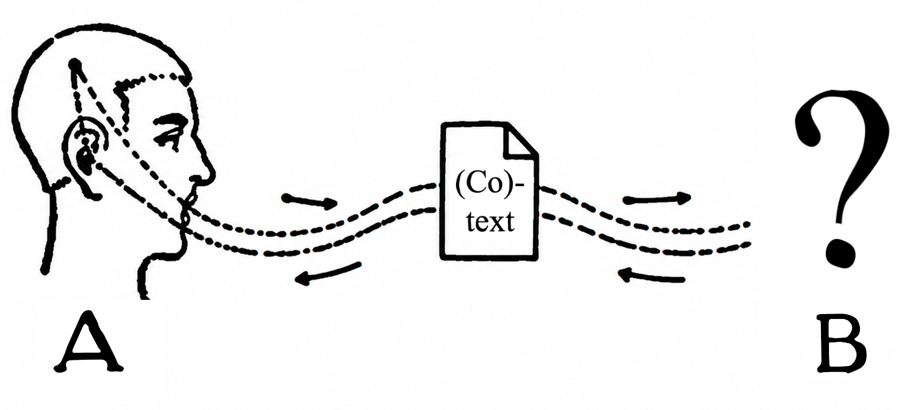
If all that is shared between sender and receiver, speaker and listener, or author and reader, is the symbolic forms exchanged through a narrow channel, then, in theory, at least the sender side could be replaced or eliminated. This idea underpins many discussions of computation, including the Turing Test. Figure 2 illustrates this concept: If A and B communicate with C only through a text-based channel, A or B could potentially be replaced with a computer without C noticing (Turing, 1948/2004). While the Turing Test is a contrived thought experiment, its laboratory setup mirrors the picture Saussure uses to explain natural communication. Instead of “facts of consciousness,” however, Turing postulates “intelligence” behind the behavior. If the machine generates text that a judge cannot distinguish from human writing, it has “passed” the test. Based on the observable behavior, we must, according to Turing, attribute intelligence to the machine.
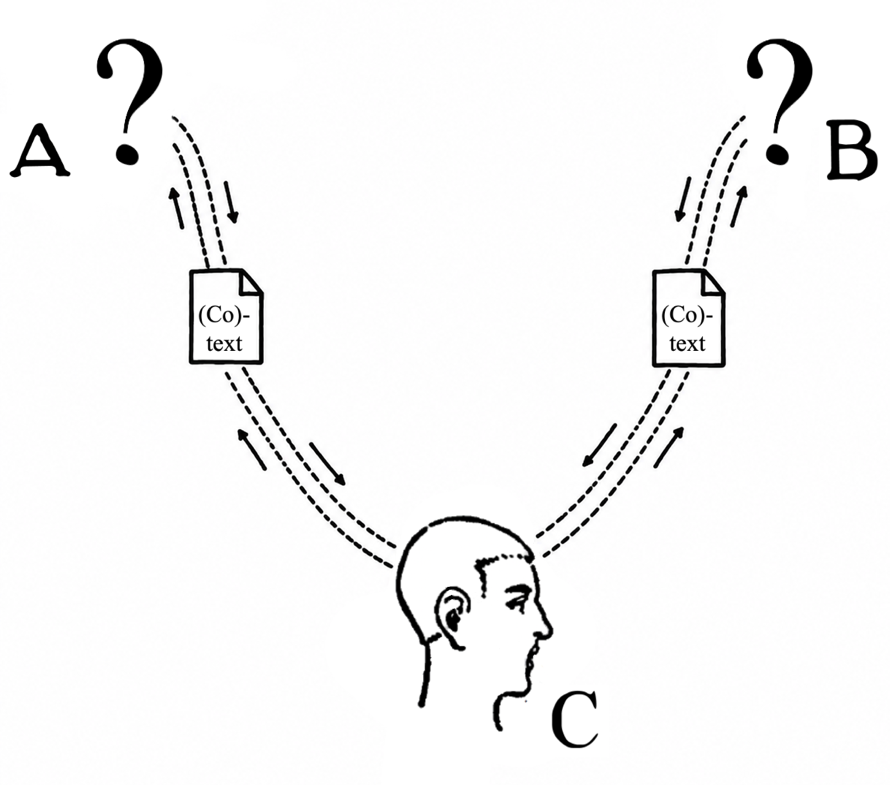
Figure 2 The Turing Test
Interestingly, the basic idea of the picture—that all that is communicated must pass through the narrow channel of symbolic language—appears across remarkably different traditions, including those that reject behavioristic or information-theoretic approaches to language. The idea that the listener or reader assigns meaning to the text, and that the author can be irrelevant, is even more prevalent. Roland Barthes articulates this in his essay “The Death of the Author,” where he elevates the reader’s role while dismissing the idea that the author creates a text’s unity: “A text’s unity lies not in its origin but in its destination” (Barthes, 1967/2020). We will come back to the precise formulation. The critiques of authorship by Barthes and his contemporaries also matter because already then the concept of the author had been challenged by computational text generation (Weizenbaum, 1966) as well as by the dispersion of authorship due to changing economic dependencies (cf. Meerhoff, 2021; Bajohr, 2023).
Recently, Elena Esposito formulated the idea that communication does not require understanding on the side of the sender. She argues that the very concept of AI is a misnomer since intelligence does not need to exist on the sender side of communication. All we can observe is the communication itself, not something we merely postulate behind it. She disagrees with Turing’s suggestion that the observable communicative behavior forces us to ascribe intelligence to the machine. Instead of the insinuated “Artificial Intelligence,” what we really have is “Artificial Communication” (Esposito, 2022, emphasis in original). In line with Niklas Luhmann’s argument against the sharing of thoughts (Luhmann, 2018, p. 193), she proposes that “[t]he thoughts of each of the participants in the communication are his or her own alone” (Esposito, 2025, p. 13). In her view, communication requires understanding only on the part of the listener or reader, not on the part of the writer.
For LLMs, the sender-receiver view of communication suggests they could simply serve the same function as a human author. In fact, the author might be nothing more than a projection by the reader—or it could just as easily be an LLM. This raises the question: Could LLMs themselves be authors? Or, if we consider that LLMs only generate text when prompted in some way: Can LLMs themselves be co-authors? Even critics who challenge the classical attribution of authorship to humans sometimes concede that LLMs can function as co-authors: “[W]e propose […] to regard humans, language, and technology as co-authors in the processes and performances of these generative models like ChatGPT” (Coeckelbergh & Gunkel, 2023, p. 2223).
Figure 3 The Questionable Entity behind a Text
From this perspective, almost anything could be an author if it plays a role in writing a text. The concept of authorship would resemble that of an actor in the “Actor-Network Theory” (ANT), which defines actors as “any thing that does modify a state of affairs by making a difference” (Latour, 2005, p. 71). Such a concept of the author is, however, too broad. Unless we want to ascribe authorship to pencils and paper, authors are more than just a thing that makes a difference in the production of text. Ascribing a very broad concept of (co-)authorship to LLMs is not a solution but takes us back to the fundamental question of the author’s role. On the other hand, claiming that LLMs are authors in the way humans are disregards potentially important differences.
Coeckelbergh and Gunkel themselves do not stick to the idea of LLMs as co-authors. In the same paper, they propose an account in which “authorship itself is (fully) deconstructed” (Coeckelbergh & Gunkel, 2023, p. 2227). They refer to the “termination and closure of the figure of the author as the authorizing agent and guarantee of what is said in and by writing” (ibid., p. 2226). This seems to contradict their earlier proposition of co-authorship: Since the deconstruction of authorship undermines the idea of co-authorship, too, it is incommensurable with ascribing co-authorship to LLMs. Not the ascription of authorship or co-authorship to LLMs, but the deconstruction of authorship itself would allow a reconsideration of the concept in the age of AI.
Deconstruction can involve, as a first step, dismissing an ill-conceived concept of authorship, such as the romantic concept of the author as the authority who endows meaning to the texts they write. But rejecting one misguided concept of the author does not say much about other concepts. The concept of author remains useful in ordinary discourse, as well as in societies that bring together and represent real authors, such as the Hellenic Authors’ Society. The authors who produce novels, poetry, fiction, or scientific work—as well as artists and creators in general—are real, and they are not arbitrarily replaceable.
Yet, LLMs have a profound impact on writing and authorship. It would be premature to jump from the fact that LLMs can be used to challenge a particular concept of writing, authorship, or truth, to the conclusion that “large language models and generative AI do not threaten writing, the figure of the author, or the concept of truth. They only threaten a particular and limited conceptualization […]” (Gunkel, 2025, p. 75). Gunkel’s admission that his argument does not contradict the concept of author per se, but only a certain conception of authorship, is appropriate. But it is reassuring only on the surface. Real existing authors are usually less concerned about threats LLMs present to an illusory concept of authorship than with the threats they present to writing and authorship itself. This concern is not just about narrow questions of AI replacing human work, but also about the fundamental impact of LLMs on writing, authorship, and truth. Even after the concept of the author as an authority is dismissed, there remain other ways in which LLMs may threaten writing, authorship, and truth. To better understand the underlying reasons, we must continue reconsidering the concept of authorship.
Already Foucault points out that the deconstruction of authorship is not finished after dismissing an ill-conceived concept: “It is not enough to declare that we should do without the writer (the author) and study the work itself” (Foucault, 1969/1998, p. 208). He continues by criticizing not just the idea of a unified author, but also the notion that a text itself remains static and unified: “The word work and the unity that it designates are probably as problematic as the status of the author’s individuality” (ibid.). Carrying the deconstruction of authorship further means also deconstructing the apparent unity of the work itself.
We can push this deconstruction even further by asking: should we deconstruct the receiver’s side too? The sender-receiver model presupposes three constructed concepts: (1) the speaker, author, or creator, (2) their work, and (3) the listener, reader, or watcher. This third presupposition might even apply to Barthes himself, who claims that a text’s unity lies “in its destination.”
But Barthes does not mean the reader as an actual person. While a person is shaped by their environment, history, and psychology, Barthes sees “the reader” differently: as “a man without history, without biography, without psychology; he is only that someone who holds gathered into a single field all the paths of which the text is constituted” (Barthes, 1967/2020). In line with most authors of his time, he uses the masculine form for “reader” (le lecteur)—presumably intending female readers, too—and speaks of “man” when he means ‘human’ in general. If, on the one side, “a text consists of multiple writings, issuing from several cultures and entering into dialogue with each other, into parody, into contestation” (ibid.), then, on the other side, something must unify this multiplicity in their specific interpretation. Even if the reader as a person could be deconstructed, the reader’s unity in the abstract sense would remain and thus resist deconstruction. If Barthes is right about the unity of the reader, we cannot simply dissolve the reader into a multitude.
Of course, we could still ask whether Barthes’s concept of the unity of the reader is itself a theoretical construct that can be deconstructed—potentially with a refined concept of deconstruction. This would be an interesting path to explore, but it raises intricate questions about unity and subjectivity and would again address only one part of the picture. This essay instead pursues a more radical direction of deconstruction: questioning the very conception underlying both the reification of authorial intent and the opposing position that the reader, rather than the author, determines a text’s meaning. Both positions buy into the same underlying opposition: that author and reader connect only through the written text. Rather than questioning just one side of a polar opposition, we need to question the entire sender-receiver model of communication and authorship.
The sender-receiver model assumes that in communication via symbolic expressions, everything transmitted must be conveyed through these symbols. But is this true? It certainly seems so if we think of communication as transmitting information through a physical channel. One objection might be that restricting ourselves to symbolic expression does not account for real communication, since communication usually involves more: intonation, gestures, rhythm, and so on. This is a valid and important point, but LLMs could model these elements as well. In any case, many exchanges today are mediated only by symbols. Even so, however, it is possible that not everything in the exchange of text and other symbolic expressions is reducible to these.
Beyond the conventional model of communication, we need to ask: How can we account for what is not said but implied? What about the language, skills, and knowledge we share and presuppose in every communication, and thus do not need to make explicit? What about the implicit shared understanding without which communication could not even begin? The implicit forms a crucial part of the context for what is said, so we need to reflect on it in any deconstruction. In general, not only the words we transmit but also the context in which they stand is essential to meaning.
The following examines how we understand symbolic expressions. This leads to a key insight: beyond the expressions themselves, we must consider their context. That context is not limited to the sender or receiver. It also includes the meaningful space shared between the creator and the audience. Context does not belong solely to the sender or receiver; it is at least partially shared. Moreover, a crucial function of the author is understanding, reframing, and reassembling this context. In fact, this essay will argue, the work on context is what gives rise to authorship. The authors mentioned above—Saussure, Barthes, Turing, Luhmann, Esposito, Coeckelbergh, and Gunkel—undervalue the author’s role because they do not sufficiently recognize the crucial work on context by the author.
3. Context and Deconstruction
What then is context? The clearest case for a simple—though potentially too reductive—concept comes from “Distributional Semantics” theory. For instance, linguists Boleda and Herbelot define context as the linguistic environment in which a word appears:
“In Distributional Semantics, the meaning representation for a given linguistic expression is a function of the contexts in which it occurs. Context can be defined in various ways; the most usual one is the linguistic environment in which a word appears (typically, simply the words surrounding the target word, but some approaches use more sophisticated linguistic representations encoding, e.g., syntactic relations […]” (Boleda & Herbelot, 2016, p. 624)
To distinguish this narrow concept of context from broader definitions, some linguists use the term “co-text.” Co-text consists of numerical relationships between text parts (tokens) surrounding a focal text. These relationships can include neighboring words as well as words that appear further away in a text corpus. Using “context” alone invites confusion: it is easy to conflate context in this narrow sense with context more broadly, mistakenly believing that co-text captures everything context means. This is precisely what happens in Distributional Semantics. By defining context strictly as co-text, Distributional Semantics overlooks the broader context—including situation, genre, gender, worldview, and culture. To avoid confusion, it makes sense to distinguish between co-text and context: co-text is merely one subset of context (Durt, 2025).
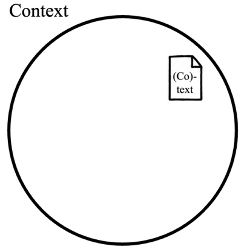
Figure 4 The Whole-Part Relationship between Context and Co-text
The concept of co-text applies well to LLMs, which fundamentally operate through co-textual relationships. The smallest operational units of LLMs are tokens. Tokens are analogous to letters in a human alphabet. LLMs use them and their order while usually disregarding the graphical and other aspects of human writing. While humans see these tokens as clusters of letters, LLMs distinguish them only by their numerical values; each token has a unique number. For humans, relationships between words carry meaning. For LLMs, these relationships exist as vectors in a multi-dimensional space far too complex for human cognition to grasp. The parallel and sequential processes of LLMs furthermore operate at speeds and levels of complexity that exceed any human’s cognitive capacity. Apart from abstract similarities in “neuronal” processing, they bear little resemblance to what we know about human brains. All of this means that once we look just a little deeper into how LLMs generate text, it becomes clear that they are not a good model of how humans produce language.
LLMs are trained to replicate patterns between numbers that correspond to text in enormous corpora. The text in these corpora comes from different contexts of actual language use: books, articles, websites, chats, and more. But within the corpora, the original contexts of language use are either disregarded or reduced to co-textual relationships. The high-speed parallel processing of massive datasets allows LLMs to produce text in superhuman ways without any understanding of the meaning of the concepts corresponding to the numbers.
If you reduce context to co-text, it easily looks like operations on co-textual relationships alone are sufficient for understanding meaning:
“Using this definition whereby understanding meaning consists of understanding networks of connections of linguistic forms, there can be no doubt that pretrained language models learn meanings. As well as word meanings, they learn much about the world.” (Manning, 2022, p. 135)
Manning even sees “inklings” and “glimpses” of Artificial General Intelligence (AGI) in LLMs (Manning 2022). Yet he can readily admit that LLMs do not understand all meaning. The idea is merely that co-text is sufficient for at least some understanding of meaning—thus LLMs can understand (some) meaning. Manning makes this plausible with the intuitive example of the word shehnai. He writes: “if I have held an Indian shehnai, then I have a reasonable idea of the meaning of the word, but I would have a richer meaning if I had also heard one being played.” Vice versa, “If I’ve never seen, felt, or heard a shehnai, but somebody tells me that it’s like a traditional Indian oboe, then the word has some meaning for me” (Manning, 2022, p. 135).
A dictionary can indeed give you a good idea of what shehnai means—assuming you already know the language in which it is written. If it were written in cuneiform, very few of us could make sense of it. Even if we knew all the relationships between cuneiform signs in a text corpus, that alone would not tell us what they mean. Similarly, since LLMs only operate on co-textual relationships, they do not learn what signs mean beyond how they’re used in a text corpus. They simply process data in a way that allows understanding beings to make sense of the reassembled output and grasp it as a contribution to a topic. Saying LLMs “partly understand” overlooks that one only gets a good idea from a dictionary entry if one already understands the language in which it was written. Philosophers have made this point in a variety of ways, including the thought experiments of Leibniz’s Mill (Leibniz, 1702, 1981, 1714/1991) and Searle’s Chinese Room (J. R. Searle, 1980; J. Searle, 2009).
Integrating multimodal data—text, sound, image, video, and potentially other sensor data—might suggest that machines are approaching a more comprehensive grasp of context. But the LLM’s work remains fundamentally about processing data: for the model, multimodal data is just relations between tokens, whether textual or otherwise. Adding sensory data and efferent motors does not provide LLMs direct access to “the world.” That access is still mediated through data and hence fundamentally constrained to co-text. One may, in addition, feed the LLM contextual information by rendering it as data or text, but this would again not be the original context but the representation of that context as co-text. This limitation is not merely practical but structural. Any attempt to fully textualize context creates an infinite regress, as each layer of explanatory co-text itself requires further contextualization.
LLMs operate exclusively in the realm of co-text, trained on textual corpora to recognize and manipulate linguistic patterns. But for LLMs to function in meaningful practices, their output has to be embedded in a broader interpretive context. The embedding in the wider context is typically done by their users, who prompt the LLM with text they understand and make sense of the LLM’s output in their respective contexts. The contextual dimension usually goes unnoticed; we tend to overlook how much human understanding shapes both the input we provide and the output we interpret, while simultaneously missing the implicit presence of the training corpus’s authors. The model itself, however, remains purely computational. It executes calculations that replicate patterns in language use without access to context beyond symbolic mediation and therefore without understanding meaning.
Even philosophers far removed from computational concepts of meaning are sometimes interpreted as promoting ideas applicable to both human sense-making and LLM text generation. In the article mentioned earlier, Gunkel interprets Jacques Derrida’s idea behind his concept of deconstruction and his neologism différance this way:
“The dictionary provides what is perhaps one of the best illustrations of this basic semiotic principle: words come to have meaning through their differential relationship to other words. In pursuing the meaning of a word in the dictionary, one remains within the system of linguistic signifiers and never gets outside language to the referent or what is typically called the ‘transcendental signified.’ This is the meaning (or at least one of the meanings) of that famous (or notorious) statement that is so often associated with Derrida (1976, 158 and 1993, 148): ‘There is nothing outside the text.’ And this is especially true for large language models, as there is, quite literally, nothing outside the texts on which they have been trained and that they in turn generate from the input of a user prompt.” (Gunkel, 2025)
Derrida’s claim is indeed often taken out of context and interpreted this way. But he later clarified that he was not referring only to textual relationships:
“One of the definitions of what is called deconstruction would be the effort to take this limitless context into account, to pay the sharpest and broadest attention possible to context, and thus to an incessant movement of recontextualization. The phrase which for some has become a sort of slogan, in general so badly understood, of deconstruction (‘there is nothing outside the text’ [il n’y a pas de hors-texte]), means nothing else: there is nothing outside context.” (Derrida, 1988, p. 136)
For Derrida, ‘context’ does not mean merely text or co-text; otherwise, he would not have needed to correct his earlier expression. Rather than disregarding context in the broader sense, he sees it as of utmost importance: Deconstruction requires paying “sharpest and broadest attention possible” to context and an “incessant movement of recontextualization.” Derrida clearly recognizes that context shapes meaning. An author’s intentions do not determine their text’s meaning. Rather, the meaning of a written text shifts as contexts change. To deconstruct the assumptions, contradictions, and binary oppositions embedded in Western thought, we must consider their context and continually recontextualize them. While LLMs operate in a world where, as Gunkel notes, literally nothing exists outside of text, humans grasp the broader context.
In fact, when we read a text, we automatically contextualize it. Words serve as a scaffold that humans use for communication, thinking, remembering, clarifying, and much more (Durt & Fuchs, 2024). A scaffold is a supporting framework used during construction. As a metaphor for building meaning with language, it reveals that symbolic language is a framework only within a broader context. This broader context is necessary for making sense of anything. Words “come to have meaning through their differential relationship to other words” (Gunkel, 2025) only when they scaffold sense-making and are embedded in that larger context.
4. Context and the Author
In the last sentence of his essay “What is an author?”, Foucault asks: “What difference does it make who is speaking?” (Foucault, 1969/1998, p. 222). He does not pretend to have answered this question, which proves more difficult than it first appears. To start exploring an answer, we can say it depends on the context. In some situations, the speaker’s identity may not matter much. But usually, knowing the author helps us assess both how seriously to take what is said and how to understand its content. The author can be part of the context we need to interpret a text. Often, the author’s intentions—including what they meant to say—matter little. Yet, analogous to Barthes’s reader, the author as a person matters less than their role in bringing together “multiple writings, issuing from several cultures and entering into dialogue” (Barthes, 1967/2020). Understanding where the author comes from and their perspective typically deepens our understanding of the text.
Setting aside the author as a specific person, it is crucial for interpretation to grasp the circumstances they come from, including their language. Language is already something shared between people. Contrary to the sender-receiver model, a text’s meaning is not “in” the author, the text, or the reader, but in between the different perspectives we can take on a text. Language itself is in flux, and the reader does not get to decide what was said.
For instance, you may read Wittgenstein’s German expression “überkommen” (Wittgenstein, 1953/2009, §23) in its modern German sense as “obsolete,” but that will distort what he meant. If you know that Austrians at that time typically used it to mean “inherited,” you can make better sense of Wittgenstein’s writings. Completely disregarding the author’s historical-linguistic perspective would resemble divination more than interpretation. It would mean reading meaning into apparent signs, i.e., projecting significance onto them, rather than understanding signs as grounded in the historical-linguistic circumstances that produced them. Sensible interpretation involves a consideration of the original context and avoids imposing contemporary or personal meanings upon them. The author’s historical-linguistic perspective matters for understanding the meaning of the writing, as does the perspective of the reader and others who have interpreted the same text.
Ordinary language distinguishes between writing a text and authoring a text: every author of a text has written it in one way or another, but not every writer qualifies as an author. This distinction entails that authorship involves more than the act of inscription itself. Writing, even when undertaken without deliberate reflection, occurs within a context that necessarily shapes the interpretation of the resulting text. We can use the notion of context to distinguish authorship from mere writing: Writers become authors when they actively engage with their context by synthesizing disparate aspects of the circumstances in which they write, integrating their affective responses, conceptual frameworks, and reasoning processes. Authors may explicitly or implicitly interrogate and transcend the constraints of their own context through their writing. Authorship is therefore an inherently complex and highly individuated creative process that establishes a new horizon of meaning for readers, who in turn approach the text from within their own contexts. Meaning is not simply transmitted but emerges from the dialectical interplay between these perspectives.
For Foucault, this interplay occurs within a “sphere of discourse,” where “one can be the author of much more than a book—one can be the author of a theory, tradition, or discipline in which other books and authors will in their turn find a place” (Foucault, 1969/1998, p. 216f). This is a very demanding concept of authorship that surely does not befit every author. But one can go beyond established frameworks without necessarily founding an entirely new theory, tradition, or discipline. By critically reflecting upon one’s own perspective and transcending the limitations of one’s context, an author can move beyond the mechanical application of existing frameworks and instead contribute to their development.
Considering different conditions of authorship allows for a non-binary concept of the author. A text does not simply possess an author or lack one; rather, there are degrees of authorship. For instance, a written shopping list does not necessarily constitute an expression of authorship. However, if such a list is carefully crafted to ironically reflect upon the interplay of need, advertisement, desire, and capitalism within a given society, then it surely qualifies as the work of an author. In between, there are the degrees of authorship. It is easy to overlook the hard work involved in authorship and believe it is simply due to “inspiration” or the “genius” of an author. But authorship is not a simple given; it is the result of persistent reflection and reworking of contexts by means of text or other media. The author’s crucial work on context, together with the fact that the context is only partly written, yields a seemingly strange insight: Authorship manifests itself not only through the written text but also through what remains unwritten and tacit.
But does this not mean that LLMs can be authors insofar as they generate carefully crafted texts? Such a conclusion would treat the text in isolation from the context in which it was produced. While LLMs can produce texts that appear insightful, they do not possess access to context except as mediated through co-textual data. However useful the generated text may be, the model merely generates it and does not qualify as its author or co-author. Nevertheless, there are authors: human writers and authors remain involved in the process. Without them, LLMs would not produce meaningful output. Taking into account the role of context for authorship allows us to reconsider the relationship between LLMs and authors.
5. LLMs and Authors
The text generation by LLMs involves many hands. They are merely more difficult to discern, because they do not appear directly, and because there are so many of them. The process encompasses multiple stages of human contribution, all of which are augmented by technology: (1) the text corpus on which LLMs are trained is predominantly written by humans; (2) the selection of training data from this corpus is conducted by humans or through automated processes supervised by humans, involving developers, investors, political actors, and legal frameworks; (3) the architectural design of the LLM itself is executed by humans; (4) the tokenization process may employ deep learning methods that are likewise developed by humans; (5) the system prompt is crafted by humans; (6) the preprocessing of input data is designed by humans; (7) generative algorithms are developed and applied by humans; (8) postprocessing procedures are designed by humans; (9) the interface and ancillary software beyond the LLM are developed by humans; and (9) the training of the model is performed by human “click-workers.” All of this constitutes human labor that occurs behind the scenes, in addition to other contributions such as the model’s prompting and the understanding of its output by end users. A thorough consideration of LLM-generated text would involve considering the authors as well as the many decisions hidden behind it.
Even if many of these contributions are not produced by authors in the substantive sense previously articulated, at least a significant portion of the text corpus was authored throughout the millennia. LLM-generated text is not authorless; its authors, along with other contributors, are merely obscured from view. Their work is frequently appropriated without adequate legal authorization or compensation for their contributions. Authorship has never been the expression of an alleged solitary genius writer, but with LLMs, it has become a highly distributed labor process. The distributed character of LLM text generation confirms that the sender-receiver model of authorship is insufficient. Beyond determining the insufficiency of this model of authorship, the above considerations allow for a reconsideration of fundamental questions concerning the impact of LLMs on authorship: What follows from attending to the respective contexts of all contributors, as well as to the shared context in which meaning emerges? What do LLMs imply for the possibility of transcending one’s context? Do LLMs hinder or promote authorship?
Since LLMs constitute a developing technology, no definitive answer can be given. Nevertheless, we can reconsider already existing uses. The most frequent use of LLMs is to prompt them to write a text. Here, the author reduces themselves to the writer of a prompt and the editor of the resulting text. This practice risks deskilling. A prompter does not need to understand the output; they need not possess competence in the language of the generated text. The result may be sufficient for many instrumental purposes, yet it distances the practice from genuine authorship more than writing the text oneself would. In many cases, the generated text does not correspond to what the prompter would have written. Sometimes that may be for the better. However, since LLMs tend to reproduce the most frequent patterns of writing in their corpora, the text they generate can be clichéd and is usually structured in predictable ways. Consequently, the most frequent use of LLMs—prompting them to generate a text instead of writing it oneself—results in a diminishment, if not abandonment, of authorship.
There are, however, other reasonable uses. Using LLMs to improve already written text can enhance texts, especially when writing in a language that is not one’s native tongue. In this case, the text is already authored, and the improvements may support that authorship. They may enhance written expression and have potentially positive effects on clarity, wording, readability, and style, such as increased use of the em dash. But they may also make the text more uniform, predictable, and clichéd, thereby potentially homogenizing the author’s distinctive voice. Furthermore, this use entails the risk of manipulation of both content and style through the many choices embedded in the distributed work behind the model. Therefore, this use of LLMs needs to proceed with care.
The considerations of authorship in the previous sections point to another use of LLMs that potentially can strengthen authorship. They may be used to research and explore contexts, provided that such contexts have been made explicit in textual form. LLMs can be used to interrogate ideas or view them from alternative perspectives. They can bring to the fore the work of other authors. They can be used to explore relationships between concepts, expand an author’s knowledge, serve as an editor, and assist with other tasks that may strengthen an author’s work.
All of this crucially involves the author, who synthesizes the different aspects of context. However, LLMs also tempt authors to delegate their work to the machine. It is then no longer the same person who sets the topic and direction of the text; who writes the text; who brings in their style, experience, history, culture, and perspective; who inhabits a particular context and history and reflects upon both; who has intentions and a will to express something; who understands, feels, and potentially genuinely expresses themselves in the text; who reveals something about themselves; who may be able to respond to interlocutors; and who thinks about readers and cares about revisions. None of these amounts to authorship by itself, but bringing them together in a temporary and open “unity” of an author is pivotal for meaningful work on context. Thus, the problem of many hands becomes the problem of relinquishing crucial aspects of authorship. Every author bears the responsibility either to abstain from the use of LLMs or to employ them and other tools in ways that augment their authorial practice rather than abdicating the fundamental work of authorship itself.
6. Literature
Bajohr, H. (2023). Autorschaft und Künstliche Intelligenz. In S. Catani (Ed.), Handbuch Künstliche Intelligenz und die Künste (pp. 265–280). De Gruyter. https://doi.org/10.1515/9783110656978-016
Barthes, R. (2020). The Death of the Author. Aspen No. 5+6, Item 3: Three Essays. https://web.archive.org/web/20200604173422/http://www.ubu.com/aspen/aspen5and6/threeEssays.html#barthes (Original work published 1967)
Boleda, G., & Herbelot, A. (2016). Formal Distributional Semantics: Introduction to the Special Issue. Computational Linguistics, 42(4), 619–635. https://doi.org/10.1162/COLI_a_00261
Coeckelbergh, M., & Gunkel, D. J. (2023). ChatGPT: Deconstructing the debate and moving it forward marked. AI & SOCIETY, 2221–2231. https://doi.org/10.1007/s00146-023-01710-4
Derrida, J. (1988). Limited Inc. Northwestern University Press.
Durt, C. (2025). The Meaning of Context and Co-text for Human Understanding and Large Language Models. Philosophy & Digitality, Special Issue on LLMs and the Patterns of Human Language Use, 2(1), 150–164.
Durt, C. (2026, March 5). LLMs and the Death of the Author [Video recording]. https://www.youtube.com/watch?v=VPjNWV3FxEI
Durt, C., & Fuchs, T. (2024). Large Language Models and the Patterns of Human Language Use. In M. Cavallaro & N. De Warren, Phenomenologies of the Digital Age (1st ed., pp. 106–121). Routledge. https://doi.org/10.4324/9781003312284-7
Esposito, E. (2022). Artificial communication: How algorithms produce social intelligence. The MIT Press.
Esposito, E. (2025). Beyond Artificial Intelligence: How Algorithms Communicate without Understanding. P&D – Philosophy & Digitality, 2(1), 8–16. https://doi.org/10.18716/pd.v2i1.11657
Foucault, M. (1998). What is an Author? In J. D. Faubion (Ed.), Aesthetics, method, and epistemology (pp. 205–222). New Press. (Original work published 1969)
Frankfurt, H. G. (2005). On bullshit. Princeton University Press.
Gunkel, D. (2025). Does Writing have a Future? Philosophy&Digitality, Special Issue on LLMs and the Patterns of Human Language Use, 2(1), 68–77. https://doi.org/10.18716/PD.V2I1.11661
Kassam, A. (2025, May 18). Musk’s AI bot Grok blames ‘programming error’ for its Holocaust denial. The Guardian. https://www.theguardian.com/technology/2025/may/18/musks-ai-bot-grok-blames-its-holocaust-scepticism-on-programming-error
Latour, B. (2005). Reassembling the social: An introduction to actor-network-theory. Oxford University Press.
Leibniz, G. W. (1702). Reply to the Thoughts on the System of Preestablished Harmony Contained in the Second Edition of Mr. Bayle’s Critical Dictionary, Article Rorarius. Histoire critique de la République des lettres, 11, 4–21. https://link.springer.com/chapter/10.1007/978-94-010-1426-7_61
Leibniz, G. W. (1981). Preface. In P. Remnant & J. Bennett (Eds.), New Essays on Human Understanding (pp. 41–70). Cambridge University Press. https://cambridge.org
Leibniz, G. W. (1991). G.W. Leibniz’s Monadology: An edition for students (N. Rescher, Ed.). University of Pittsburgh Press. (Original work published 1714)
Luhmann, N. (2018). Soziale Systeme: Grundriß einer allgemeinen Theorie (17. Auflage). Suhrkamp.
Manning, C. D. (2022). Human Language Understanding & Reasoning. Daedalus, 151(2), 127–138. https://doi.org/10.1162/daed_a_01905
Meerhoff, J. (2021). Verteilung und Zerstäubung: Zur Autorschaft computergestützter Literatur. In H. Bajohr & A. Gilbert (Eds.), Digitale Literatur II (pp. 49–61).
Saussure, F. de, Bally, C., & De Mauro, T. (1997). Cours de linguistique générale. Payot. (Original work published 1915)
Searle, J. (2009). Chinese room argument. Scholarpedia, 4(8), 3100. https://doi.org/10.4249/scholarpedia.3100
Searle, J. R. (1980). Minds, brains, and programs. Behavioral and Brain Sciences, 3(03), 417–457. https://doi.org/10.1017/S0140525X00005756
Shannon, C. E. (1948). A Mathematical Theory of Communication. Bell System Technical Journal, 27(3), 379–423. https://doi.org/10.1002/j.1538-7305.1948.tb01338.x
Turing, A. M. (2004). Intelligent Machinery. In B. J. Copeland (Ed.), The essential Turing: Seminal writings in computing, logic, philosophy, artificial intelligence, and artificial life, plus the secrets of Enigma (pp. 410–432). Clarendon Press ; Oxford University Press. (Original work published 1948)
Watson, J. B. (1924). Behaviorism. People’s Institute Publishing Company.
Weizenbaum, J. (1966). Eliza—A computer program for the study of natural language communication between man and machine.
Wittgenstein, L. (2009). Philosophische Untersuchungen =: Philosophical investigations (G. E. M. Anscombe, P. M. S. Hacker, & J. Schulte, Trans.; Rev. 4th ed). Wiley-Blackwell. (Original work published 1953)
[1] “Le point de départ du circuit est dans le cerveau de l’une, par exemple A, où les faits de conscience, que nous appellerons concepts, se trouvent associés aux représentations des signes linguistiques ou images acoustiques servant à leur expression.” (Saussure et al., 1915/1997, p. 28)